Wednesday, October 6, 2021

Post 21: The 2020 Census -- Preliminary Conclusions

 A little over a month ago, the Census Bureau released the first batch of data from the 2020 Census.  Thirty or forty years ago this would have been front page news, but this year it hardly caused a ripple.  My guess is that the lack of excitement is a result of two factors: (1) the Bureau’s own annual estimates have become so accurate and comprehensive that the numbers from the decennial census are not much of a surprise anymore, and (2) it is pretty hard for population counts to complete with a global pandemic, climate change, and trillion dollar budget packages.


Anyway, to a city planner like me the Census numbers are still interesting and the trends they reveal are important.  This initial release has a very limited scope -- designed mainly to facilitate reapportionment and redistricting -- so any real analysis will need to wait until the more detailed data releases that will be coming out over the next year or so.  But I think it is possible to draw some early conclusions on issues relating to broad population trends.


Before jumping into the data, however, there is an important caveat to this census that needs to be understood.  The actual census date was in April of 2020, roughly one month into the COVID-19 pandemic.  That means that very few of the relocations which took place in response to the pandemic -- particularly the shift to remote work -- will be reflected in the data.  It remains to be seen whether the changes that took place will be long term or whether things will revert to prior patterns after a couple of years, but there definitely were changes and the scope and duration of those changes are not yet fully understood.


In keeping with the theme of this blog, I’m going to focus on the midwestern states and major cities although I will start with some national trends to provide context.  I’ll use the Census Bureau definition of the midwest region which includes 12 states ranging from Ohio and Michigan in the northeast to Nebraska, Kansas and Missouri in the southwest.


National Trends


The national population numbers don’t really reveal many surprises.  The trends are generally continuations of trends that have been in place for at least several decades.  The U.S. population grew over the past decade by 7.3%, but that reflects a continuing slowdown in the rate of growth (roughly 13% for 1990 to 2000, and just over 10% for 2000 to 2010).  The long running decline in birth rates is the primary cause, along with a decline in immigration particularly during the Trump years.


Birth rates have been slowly dropping for decades (from a high of over 3.5 births per woman during the 1950s to under 2 births per woman now) and I don’t anticipate that will trend upward anytime soon, although it seems to be stabilizing.  Many people are choosing not to have children at all and those that do are often waiting until they are older to begin having children which leaves less time for large families to form.  Over the past 50 years, a women’s average age at first birth has increased from roughly 21.4 years to 26.8 years. [1]  The inevitable result, confirmed by the 2020 Census, is that the U.S. population is getting older.  In fact, there were fewer people less than 18 years of age in 2020 than there were in 2010 (73 million vs. 74 million), something that hasn’t happened since 1980.  Still, natural population increase (births minus deaths) is a major source of growth for the U.S. and that will continue for many years (although it will slowly dwindle over time).  This stands in contrast to many other developed countries where natural population change is already nearly zero or slightly declining.
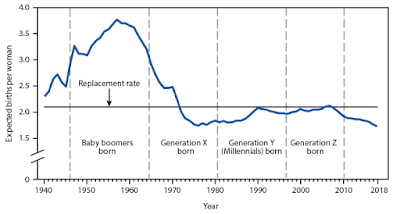

Birth Rates Over Time

The other component to population change is migration.  The United States has always been a net importer of people and we continue to be an attractive destination for people from all around the world.  Historically, we have added roughly a million people per year through immigration although that number dropped to less than 600,000 during the final years of the Trump administration.  Forecasting future immigration is dependent on future political decisions, but it is certainly possible that we will have more population growth from immigration than from natural increase by sometime in the late 2020s or early 2030s.  The main recipients of international immigration are naturally the big cities, mainly on the two coasts.  Chicago is the only midwestern city with a large immigrant inflow.

Thanks to immigration, the U.S. population is also becoming more diverse.  The Census Bureau revised the way in which it asked about racial and ethnic backgrounds to give people greater flexibility to specify how they viewed themselves.  One result of this change is that the number of people who identify as “white only” dropped considerably and the number of people who identify as multiracial increased considerably.  This is not so much an actual change to the racial mix of the population as it is a change to the way people express who they are.  But regardless of how the question is asked, the U.S. is more diverse than ever and that trend is likely to continue.


The distribution of the population across the 50 states also followed trends that have been well documented in recent years.  The south had several states (Texas, Florida, Georgia) that were among the top five in absolute population gain, and the west had 5 states (Utah, Idaho, Nevada, Colorado, Washington) that were in the top 10 for the rate of population growth.  The anomalies were North Dakota and Delaware which both had double digit growth rates in regions of slower growth.  Only three states declined in population (West Virginia, Mississippi and Illinois).


Since only a few states consistently have a natural population decrease  (only four in 2019: West Virginia, New Hampshire, Maine and Vermont), the primary differentiator of population change is the net difference in international immigration and domestic migration.  Migration patterns can fluctuate from year to year and are not easy to accurately pin down, but the general patterns are fairly consistent.  Florida, California, New York and Texas tend to be high on the list of international immigrant destinations.  Midwestern states other than Illinois tend to be in the middle of the pack.  Domestic migration tends to favor the south and the west, with Indiana being the only midwestern state to make the top 20 list in 2018-2019.  California, New York and Illinois are the states with consistently large domestic out-migration.  The midwestern states of Michigan, Ohio and Kansas also tend to suffer from out-migration more often than not.


States in the Midwest


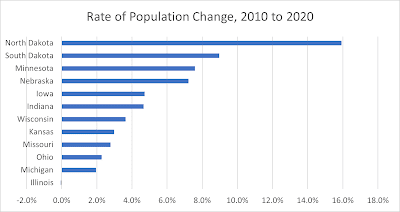
During the 2010 to 2020 period, the midwest region grew by 3.1 percent -- less than half the national rate.  This is consistent with the trend of the last several decades.  Consequently, the region’s share of the national population dropped from 24 percent in 1990 to just under 21 percent in 2020.  All of the states did show positive growth, however, with the exception of Illinois whose population declined by just one tenth of one percent.  


Minnesota, Indiana and Ohio were the top states in terms of population gain with increases of roughly 400,000, 300,000 and 260,000 respectively.  In terms of the rate of population increase, North Dakota (15.9%), South Dakota (9%), Minnesota (7.6%) and Nebraska (7.4%) led the way.  These same states were the only ones to grow at a rate faster than the country as a whole (7.3%).

One of the interesting national statistics is that despite growing by 22 million people, more than half of all counties in the U.S. declined in population during the last decade.  That trend holds true for the midwest and is, in fact, exaggerated -- particularly for states which are heavily focused on agriculture.  As agriculture has become increasingly mechanized, the number of people required for farming has steadily dropped.  And as personal transportation options have improved, the commercial businesses and public institutions supporting the rural population have clustered into a few regional cities rather than the scattered network of small towns that were needed a hundred years ago when travel was more time consuming.  In short, the forces that favor agglomeration are winning out over the forces that favor dispersion.


I calculated two measures of this tendency for each state:  (1) the percentage of counties that grew in population from 2010 to 2020, and (2) the number of counties that could account for all of a state’s population growth (i.e., the degree of population concentration).  The states where rural decline was most widespread were Illinois, Kansas, Nebraska, Missouri and Iowa -- all of which had a decreasing population in over two-thirds of their counties.    Only Wisconsin and Minnesota, states with significant recreational opportunities in rural areas, had growth in more than half of their counties.


In terms of states with a highly concentrated population growth, the most notable examples were Kansas (2 counties out of 105 accounted for all growth), Nebraska (3 counties out of 93), Missouri (5 counties out of 115), and Iowa (5 counties out of 99).  In short, people in agricultural states are attracted to the few large cities that these states contain because they offer job opportunities, earning potential and social amenities that small towns and rural counties cannot match.  At the other end of the spectrum, Wisconsin (26 counties out of 72) and Minnesota (21 counties out of 87) showed the least concentration of population growth.


Cities in the Midwest


Given the relatively lackluster growth performance at the state level, it would be logical to assume that midwestern cities are in the same boat.  And yes, out of the 23 metropolitan areas with a population of over 300,000, there are five that lost population during the past decade (Flint, Peoria, Rockford, Chicago and Davenport).  But the other 18 gained in population and 13 of those gained at a rate that exceeded the average growth rate for the region.  Nine of the metro areas (Des Moines, Columbus, Lincoln, Indianapolis, Omaha, Minneapolis, Grand Rapids, Springfield, and Kansas City) grew at rates that exceeded the national growth rate.  So there are a significant number of urban areas that are doing just fine.


It is also interesting to look at the primary city in each of the 23 metro areas.  In more than half of the cases, the core city grew faster in the past decade than the metro area as a whole.  Omaha, Columbus, Lincoln, Minneapolis, Kansas City and Ann Arbor not only grew faster than their associated metro area during the 2010 to 2020 time period, they also grew at a more rapid rate than the country as a whole.
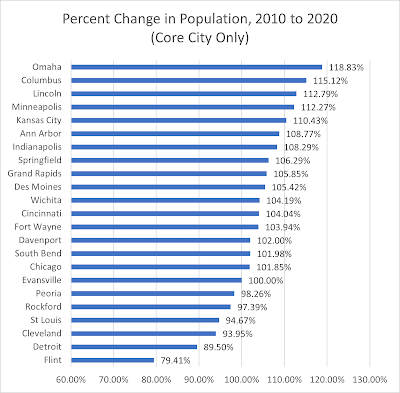


In addition, there is clear evidence that the primary cities did better in the most recent decade than from 2000 to 2010, and out-performed the overall metro areas in the same comparison.  For example, only 5 of the 23 metro areas grew faster during the 2010 to 2020 time period than during the 2000 to 2010 time period.  But 17 of the primary cities grew faster between 2010 and 2020 compared with 2000 to 2010.  In addition, five of the primary cities that gained population in the most recent decade had lost population between 2000 and 2010.  This trend needs further study with more detailed census results, but these numbers appear to be pointing toward a rebirth of the urban core during recent years.


Moving Forward


Civic leaders and Chamber of Commerce types often chase population growth as if it were an essential ingredient of a successful city.  I would argue that a focus on population growth is not nearly as useful as a focus on economic growth.  It is economic growth that provides households with a path to a better lifestyle, and perhaps more importantly, a path for those living in poverty to become economically successful.  The two things are linked, but population growth does not necessarily lead to the scale of economic growth that can improve lifestyles across the community.  The missing ingredient is productivity.  Cities have to find ways to improve the productivity of the workforce in ways that match the needs of businesses that have the potential for growth.


Thus, the secret to economic growth is to simultaneously attract (or nurture) businesses with growth potential and workers with the skills that those businesses need.  I will return to the topic of economic growth in future posts, but for now I will simply say that I think many midwestern cities are on the wrong track.  They have workers whose skills are declining in demand and they have businesses with limited growth potential.  Getting out of this rut will require understanding that the future will be different from the past.


Suffice it to say that I think the road to economic vibrancy will not be paved with economic incentives to out-of-town firms or with bigger convention centers or with new stadiums for professional sports teams.  Cities would be better off focusing on an efficient hard infrastructure (transportation systems and utility services) that businesses and citizens need to be productive,

and on a robust soft infrastructure (educational systems, health services, and the art/music/festival/recreation scene) which make cities an attractive place to live.


Thoughts?  As always, share your thoughts and ideas by leaving a comment below or sending me an email at doug@midwesturbanism.com.  Want to be notified whenever I add a new posting?  Send me an email with your name and email address.


Notes:


  1.  Karen Guzzo and Krista Payne; “Average Age at First Birth, 1970 & 2017”; National Center for Family and Marriage Research, Bowling Green State University; 2018; https://docs.google.com/document/d/1Qz5Ma8qo7B-cIX8CMM1YIIr5CRKqvrKPv87VBEsioWw/edit.

  2. Unless otherwise noted, all statistics are based on data from the U.S. Census Bureau.

Monday, September 6, 2021

Post 20: In Defense of Gentrification


 In 1964, British sociologist Ruth Glass coined the term “gentrification” to describe working-class London neighborhoods that were being changed by new residents who were much more affluent.  “One by one, many of the working-class quarters of London have been invaded by the middle-class … until all or most of the working-class occupiers are displaced and the whole social character of the district is changed.” [1] 

Since that time, the meaning of gentrification has broadened to include nearly any situation in which affluent people are residing and investing in a formerly run-down neighborhood. This is an unfortunate shift because it now lumps situations which are largely beneficial with a far smaller number of situations in which real problems result from the influx of people and money.


Even more worrisome is that in many circles, including much of the popular press, the term gentrification has become a pejorative -- laden with all sorts of negative connotations.  To be accused of participating in gentrification is seemingly just a step or two better than being accused of being a racist.  Director Spike Lee considers it to be little more than a neocolonialist land grab, or as he more colorfully puts it:  “the motherf***ing Christopher Columbus Syndrome.” [2] 


Most commentators are a bit more polite, but exaggerations and mischaracterizations still abound.  I could easily cite stories from around the country, but two examples from my normally laid back hometown of Kansas City will suffice.  In one local news story, a neighborhood activist equated gentrification with “ethnic cleansing.” [3]  In a second example, the Kansas City Star ran an editorial titled “Stop the Denverization of Kansas City.  Troost doesn’t need to be hipster friendly.” [4]  Troost Avenue is the street that has historically been the dividing line between affluent neighborhoods that are predominantly white and more disadvantaged neighborhoods that are more heavily black.  Apparently, the editors at The Star consider the integration caused by white people moving into a largely black neighborhood to be a bad thing.  They specifically  took issue with a project on Troost that rehabbed a former industrial bakery because the rent for a two-bedroom unit started at $1,100.  Adding several dozen residences along with several storefronts and restaurants in a building that was vacant is presumably a terrible thing for the neighborhood because it might attract “hipsters” or other people who don’t match the characteristics of the current residents.


While the original usage of the term gentrification focused mainly on differences in economic status and social class, more recently elements of racial and generational differences have been added to the mix.  In the United States in particular, incoming residents in gentrifying neighborhoods tend to be both whiter and younger.


The Crossroads neighborhood in Kansas City

To be fair, when a neighborhood gentrifies there can be negative consequences and it obviously can make people uncomfortable.  I’m not going to ignore those negative consequences, but I will argue that there are typically far more positive effects that result from reinvestment in declining neighborhoods than negative ones, especially in Midwestern cities.  I will also do my best to back my arguments with the latest research rather than rely on knee-jerk reactions from residents who are afraid of change.


The Problem of Change


Cities are constantly evolving.  Nothing about a city is truly static but we lose sight of that truth because change often happens so slowly that a given neighborhood might appear to be static until something dramatic occurs.  At the same time, human beings have a strong predisposition toward the status quo.  We are adaptable -- but change takes work and unless we are motivated to incorporate change into our lives we prefer to have things stay the same.


This is particularly true of the neighborhoods in which we live.  All of us want to feel comfortable and accepted in our neighborhoods, so many of us like living in an area where the other residents are like us and the residential units that others live in are more or less like ours.  It is easier to understand and relate to your neighbors if you share a common racial, economic or ethnic background.  At the very least, we like a neighborhood where the resident mix is stable because when the resident mix changes, it makes us uncomfortable.  Will I know how to relate to my new neighbors?  What if the new group expands rapidly and I become the outsider?  Will my values and lifestyle be accepted by the new residents or will they expect me to change?  The common reaction is to push back against the incoming group before any of these questions can be answered.  It is an instinctive negative reaction even if the change might prove to be positive in the long run.


The Westside neighborhood in Kansas City

A related problem is that humans have a heavy bias toward the recent past, as opposed to the long-term view of history.  The Tony award winning musical “In the Heights” is a bittersweet story of a latinx neighborhood in New York City that is undergoing gentrification.  Old businesses are relocating because they are being out-bid for commercial space and the residents are torn between staying or moving on.  The story-line follows the reaction to these changes by a variety of characters, but the common thread is that something valuable is being lost in the gentrification process.  What the story doesn’t explain is that Washington Heights has a long history that includes not only a variety of urban forms but an even wider variety of resident populations.  The early development of the Heights was fueled by Irish and Eastern European immigrants, followed by an influx of German Jews, and then immigrants from Greece, Cuba and Russia.  Surely those transitions were every bit as bittersweet as the one portrayed by In the Heights.


My point is that neighborhood change is normal and we should be encouraging people to be accepting of that change.  Deal with the problems but embrace the opportunities for making the future better than the past.  What I find particularly disheartening about much of the rhetoric surrounding gentrification are the eerie similarities to the rationales used against blacks moving into white neighborhoods in the 60s, 70s and 80s.  “Those people have different values than we do” or “We won’t be able to preserve the character of our neighborhood.”  Those types of statements are simply code for “I just want to live with people who are like me.”  As a society, we need to be better than that.  Integration should be a goal for all neighborhoods, regardless of who the base population is at any given moment.


The Issue of Displacement


The issue that is frequently cited as the most significant problem with gentrification is the displacement of low-income or disadvantaged households.  As a neighborhood gentrifies, the theory is that long-term residents are forced out of the neighborhood either indirectly through rising rents or directly by landlords who are seeking redevelopment opportunities aimed at attracting more affluent residents.


This type of displacement can have devastating effects on low-income households.  First, such households may need to move further out to find replacement housing, generally making their commutes more difficult (or expensive) and often raising their cost of housing in the process.  Second, displacement can disrupt the fragile institutional, community and social networks that disadvantaged households often rely upon to simply survive.  A household with major health issues may have found nearby medical resources tailored to people with lower incomes.  Or a household with a disabled person may have found neighbors or community groups willing to assist with transportation needs.  Or a low income household may have found ways to get by through social connections to people who are willing to barter or discount their services (“I know a guy who will repair your AC for just the cost of parts.”)  In any case, disrupting these networks through a forced move can push struggling households over the edge into complete dysfunction.


This type of displacement does occur and its effects are real.  However, it occurs far less than you would think from listening to the general discussion of gentrification.  Anecdotal horror stories spread quickly, but reality is far more nuanced.  The problem appears to be most severe in the so-called “superstar” cities such as New York, San Francisco, Boston, Washington DC, or Seattle where housing prices are spiralling out of control. But even in these cities with rapidly growing economies, studies of displacement have produced surprising results.


Lance Freeman, a professor at Columbia University, has done several studies that concluded that direct displacement of long-term, low-income residents by affluent in-migrants is relatively rare. [5]  More common was the exclusion of potential low-income households that might otherwise have moved in except for the impact of rising rents.  In his book “There Goes the Hood:  Views of Gentrification from the Ground Up,” Freeman found that resident’s views on gentrification were ambivalent.  Many long-term residents liked the improved access to services and amenities that came with gentrification as long as that gentrification didn’t lead to their displacement. [6]


A 2016 study in Philadelphia compared the likelihood of a household moving in neighborhoods that were gentrifying versus those that were not.  They focused on households with low credit scores (a proxy for low income), including both households with mortgages (homeowners) and without (renters).  The authors concluded that:


“The results suggest that the low-score residents and low-score residents without mortgages in gentrifying neighborhoods are generally no more likely to move than similar residents in non-gentrifying neighborhoods.” [7]


A similar study in New York City using Medicaid data focused on possible displacement of low-income households with children.  The authors of this study found that children in low-income households living in gentrifying neighborhoods were no more likely to move than similar children in non-gentrifying neighborhoods.  This conclusion held true regardless of whether the families were living in subsidized or market-rate housing.  Furthermore, they concluded that:


“Contrary to fears voiced by many, we find that the average low-income child who starts out in areas that later gentrify experiences a reduction in neighborhood poverty, mainly because the majority do not move as neighborhood income rises around them.” [8]


Finally, the reality of gentrification, particularly in the midwest, is that occupied residential units are often not even involved in the process.  It is common for the majority of “gentrified housing” to come from obsolete industrial or commercial properties that are converted to trendy upscale housing.  Thus, there can be no displacement of any sort.  To return to The Star editorial that I referenced earlier, I fail to see how rehabbing a vacant industrial bakery which had zero residential units into a thriving development with more than 80 residential units can be a bad thing, regardless of rent levels.


The Positive Side of Gentrification


Although in theory gentrification could happen in all but the most wealthy neighborhoods, in practice it almost always occurs in neighborhoods that have shown significant decline or outright blight, often caused by decades of disinvestment.  What is rarely discussed by those decrying gentrification is what the alternative would be.  The unstated assumption seems to be that -- were it not for gentrification -- these neighborhoods would continue into the future unchanged.  That is almost assuredly not the case.  Neighborhoods that are in decline do not suddenly stabilize, they continue to decline until there is some form of substantial and on-going reinvestment (almost always in the form of either gentrification or a conversion to some completely different use) or until they reach the point where owners simply abandon their property.  My point is that preventing a given neighborhood from gentrifying almost guarantees that it will continue down a path of ever worsening poverty and decay.


The reinvestment that is an essential part of gentrification is a badly needed economic boost.  It provides a new lease on life to declining buildings and neighborhoods.  It is not a recent aberration, it is a normal and largely beneficial part of the urban development cycle.  What is relatively new is that recent gentrification has reversed a long-running abandonment of the urban core, particularly by whites, during the last decades of the 20th century.  What is ironic is that many of the planners and urban activists that decried the abandonment of the urban core are the very same people who are now decrying its antidote.


In addition to the economic boost, I would argue that gentrification has the potential to provide a social benefit.  Increasing the economic and racial integration of neighborhoods has been a long standing part of this country’s housing policy.  As it turns out, gentrification is an effective way to increase neighborhood diversity.  A recent article by Jason Barr cites a study of over 400 U.S. cities that concluded:


“The neighborhoods that have integrated through gentrification have remained racially integrated for longer periods of time than the conventional wisdom suggests.  Many are seeing little change in their white population share in the decades following gentrification.  Indeed, neighborhoods that became integrated through gentrification appeared to be more racially stable than those that integrated through households of color moving into predominantly white neighborhoods.” [9]


Racial and economic integration is always an uncomfortable process, but I am convinced that it has been and will continue to be beneficial for our society.


Finally, it is common for gentrifying neighborhoods to have an increase in the total number of residential units.  Often the increase is substantial, due to vacant industrial or commercial sites being converted or redeveloped as mid-rise or high-rise apartment buildings or condominiums.  These developments are often criticized for fueling rent increases throughout the neighborhood.  Unfortunately, this is almost always a case of correlation being confused with causation.  Rents may be rising for a variety of reasons, but it is rarely because of new housing complexes being constructed.  Recent studies have concluded that increasing the housing supply -- even at luxury rent levels -- either has no effect on rent or leads to a reduction. [10] This is simple supply and demand economics at work.


Masking the Real Problem


Aside from the fact that it is often misguided, the more troubling consequence of the potshots being taken by journalists and pundits at affluent whites moving to gentrified neighborhoods is that it distracts from a far more serious and widespread problem.  Leading urban researchers have repeatedly pointed out that the concentration of low income households in declining neighborhoods is a far larger and more destructive issue than gentrification.


A recent report titled “American Neighborhood Change in the 21st Century:  Gentrification and Decline” which studied the 50 largest metro areas in the country contains some sobering statistics:


“The most common form of neighborhood change, by far, is poverty concentration.”


“As of 2016, there was no metropolitan region in the nation where a low-income person was more likely to live in an economically expanding neighborhood than an economically declining neighborhood.”


“On net, far fewer low-income residents are affected by displacement than concentration.  Since 2000, the low-income population of economically expanding areas has fallen by 464,000, while the low-income population of economically declining areas has grown by 5,369,000.” [11]


Despite the disheartening implications of these numbers, the popular press has been virtually silent on this issue, although that is starting to change among the more thoughtful urban scholars.  In his book “The New Urban Crisis,” Richard Florida devotes an entire chapter to the subject of gentrification but ends the chapter talking about the much larger number of neighborhoods that it bypasses entirely and where racially concentrated poverty persists and continues to deepen.  He comes to this conclusion:


“Rather than knee-jerk resistance to change or attacks on new urbanites, the more appropriate response is to assist those who are most vulnerable.  It makes little sense to discourage investment in cities and urban neighborhoods, especially in places that desperately need it.  Indeed, the real task of urban policy is not to try to stop the market forces that are leading to the economic revitalization of certain urban areas, but to improve the housing options, economic opportunities, and neighborhood conditions of those who are being left behind . . .” [12]


Moving Forward


It is easy to feel sympathy for low-income households that struggle every day with a variety of issues, not the least of which is finding decent and affordable housing.  It is almost as easy to feel some level of contempt for young, privileged whites who are often clueless about the ways in which their sense of entitlement affects those from different economic and racial groups.  When it comes to solving urban problems, however, we shouldn’t settle for easy answers fueled by stereotypes, anecdotal stories and fear of change.


Systemic poverty and unequal access to economic opportunities -- magnified by social ills such as racism, violence and drug addiction -- have created divisions in our society that undercut our ability to move forward with any type of cooperative action.  It is these problems that deserve our focus rather than the straw man of gentrification.  In fact, gentrification might provide opportunities to address those larger, societal problems.  Perhaps cities should look for ways to ensure that minority owned businesses share in the economic infusion that accompanies gentrification rather than chase it away.  Or perhaps the increase in taxable value that results from gentrification should be tapped as a way to boost affordable housing so that displacement is minimized.  I’m sure there are creative solutions that focus more on harnessing the momentum of gentrification to improve the lives of disadvantaged families, rather than clinging to a past that provides no solution at all.


Thoughts?  As always, share your thoughts and ideas by leaving a comment below or sending me an email at doug@midwesturbanism.com.  Want to be notified whenever I add a new posting?  Send me an email with your name and email address.


Notes:


  1. Ruth Glass; “London:  Aspects of Change”; (London: MacGibbon and Kee, 1964).

  2. Joe Coscarelli; “Spike Lee’s Amazing Rant Against Gentrification:  We Been Here!”; New York Magazine, February 25, 2014.

  3. Imani Berry, Neika Capelton, Blue Cowdin, Bettye Ray, Dominic Zamora; “Pitting neighbors against neighbors: The impacts of gentrification in Kansas City’s Westside”; KSHB, January 2020; https://www.kshb.com/news/local-news/pitting-neighbors-against-neighbors-the-impacts-of-gentrification-in-kanas-citys-westside

  4. The Kansas City Star Editorial Board; “Stop the Denverization of Kansas City.  Troost doesn’t need to be hipster-friendly”; The Kansas City Star, November 2018; https://www.kansascity.com/article222202495.html

  5. Lance Freeman; “Displacement or Succession?  Residential Mobility in Gentrifying Neighborhoods”; Urban Affairs Review 40, (no. 4) 2005.

  6. Lance Freeman; “There Goes the ‘Hood:  Views of Gentrification from the Ground Up”; (Philadelphia, Temple University Press, 2006).

  7. Lei Ding, Jackelyn Hwang, Eileen Divringi; “Gentrification and residential mobility in Philadelphia”; Regional Science and Urban Economics; 2016; https://ideas.repec.org/a/eee/regeco/v61y2016icp38-51.html

  8. Kacie Dragan, Ingrid Gould Ellen, Sherry Glied; “Does gentrification displace poor children and their families? New evidence from medicaid data in New York City”; Regional Science and Urban Economics; July 2020; https://www.sciencedirect.com/science/article/abs/pii/S0166046219302194

  9. Jason Barr; “Is Gentrification Good or Bad?”; Building the Skyline; November 2019; https://buildingtheskyline.org/gentrification-1/.

  10. Joe Cortwright; “Building more housing lowers rents for everyone”; City Observatory; December 2020; https://cityobservatory.org/building-more-housing-lowers-rents-for-everyone/

  11. Institute on Metropolitan Opportunity; “American Neighborhood Change in the 21st Century: Gentrification and Decline”; University of Minnesota Law School; April 2019; https://www.law.umn.edu/institute-metropolitan-opportunity/gentrification

  12. Richard Florida; “The New Urban Crisis:  How our cities are increasing inequality, deepening segregation, and failing the middle class -- and what we can do about it”; (Basic Books, April 2017).


Saturday, July 31, 2021

Post 19: The Reality of Deferred Maintenance

Ooh, spare your heart

Everything put together

Sooner or later falls apart


When Paul Simon wrote those lyrics, I’m pretty sure he was talking about the complicated lives that we build and the false facades that we project for others.  But it applies just as well to the physical things that we build including cities and buildings.  And we all know that the things that we build eventually fall apart, but we often pretend as if they will last forever.


On June 24th, a 12-story beachfront condominium tower in Surfside, Florida, partially collapsed killing 98 people.  It is too early to know the exact cause, but it appears as though there had been some long-term degradation of concrete structural supports which probably was a major contributing factor, if not the primary cause.  Worrisome cracks had been identified by an engineering inspection at least 3 years ago, and yet no corrective action had been taken.


Source:  Chandan Khanna; AFP/Getty Images

This tragic event made me think about the issue of deferred maintenance -- by which I mean maintenance actions that are generally acknowledged as needed but which don’t get done for one reason or another.  In almost every case, there is some intent to do the required work eventually, just not when it was originally thought to be needed.  The condo association board was aware that there were potential structural issues, but they probably didn’t grasp the potential severity of the problem and they were undoubtedly operating with budgetary constraints.  Again, there have been no conclusions drawn about whether deferred maintenance was a contributing factor, but I would be stunned if that is not the case.


Although the Surfside condo collapse motivated me to write this post, it is just the latest example in a long string of similar failures linked at least partially to maintenance needs that were missed or ignored for too long.  The damage to the New Orleans area caused by Hurricane Katrina was far worse than it should have been due to numerous failures in the levee system designed to protect the city.  The levees failed in ways that had been predicted by studies in 2000 and 2004 that modeled the effects of a large hurricane, and yet no significant changes were made by the patchwork system of governmental agencies tasked with maintaining and improving the levee system. [1]


The New York City subway system is literally crumbling due to an enormous backlog of maintenance projects.  Some replacement parts have to be made by hand when they fail because they haven’t been manufactured for years.  An article by the New York Times Magazine estimated the cost of correcting all of the problems at over $100 billion.


Several of the recent wildfires in California, including the one that destroyed the town of Paradise, were caused by failures of PG&E’s electrical system infrastructure.  An article by the Wall Street Journal concluded that “PG&E Corp. knew for years that hundreds of miles of high-voltage power lines could fail and spark fires, yet it repeatedly failed to perform the necessary upgrades.” [2]


My home town of Kansas City, Missouri, has operated its sewer system under a consent decree with the Environmental Protection Agency since 2010 due to decades of deferred maintenance that led to repeated releases of untreated sewage.  Although this type of maintenance problem is rarely viewed by the public as being catastrophic in the same way as the Surfside condo collapse, its impact is still substantial despite being harder to quantify and much less graphic.


Sadly, the examples listed above are not the exception.  Virtually every governmental agency that has responsibility for infrastructure maintenance has this same problem to one degree or another.  In fact, I would wager that the majority of such governmental agencies have a backlog of maintenance needs that exceeds their annual maintenance budget several times over.  Many such infrastructure needs have the potential to be catastrophic -- bridges, dams, high-rise structures, for example -- but the impact of even the more mundane items such as streets, water lines, electrical and gas networks can have a big impact on the quality of life for area residents.


How bad is it?


The answer to this question is probably “Better than you think” and “Worse than you think” all at the same time.  Major structures are over-designed with a significant safety factor built into their construction.  Estimates of “useful life” are typically on the conservative side and the schedules for recommended maintenance tend toward the “in a perfect world” scenario.  So when engineers come up with numbers about how far behind we are in maintaining our infrastructure and the billions of dollars it will take to get caught up, it is fine to be somewhat skeptical and to avoid “the sky is falling” types of hysteria.


In addition, many pieces of infrastructure or equipment can function just fine even if the ideal maintenance schedules are not followed.  Yes, we know we should get our car serviced every 5,000 miles, but it will probably be fine if we go 8,000 or even 10,000 miles on occasion.  The fact is that many things work acceptably well even if their condition is less than optimal.  My neighborhood, for example, has numerous street sections that have been repeatedly patched and the gutters are cracked or crumbling, but traffic moves just fine.  We may complain about the condition of the streets but it doesn’t significantly impede our daily tasks.


Furthermore, it isn’t always a bad thing when something fails.  Sure it is temporarily annoying, but it provides an opportunity to upgrade or replace the failed thing with something better.  There is an old real estate adage that goes something like “we aren’t over-built, we are under-demolished.”  Cities need to be re-invented and re-created from time to time, although letting things fail due to neglect is a pretty random and inefficient method of deciding what should be re-created.


On the other hand, I think we need to acknowledge that humans as a species are much better at building something new than we are at maintaining what we have.  We are genetically wired with decision-making biases that strongly favor actions with an immediate pay-off versus those where the benefit is at some undefined future point.  This is particularly true for politicians who know that spending $20 million on a new community center will gain them more votes in the next election than spending the same amount replacing water lines that are at the end of their useful life.  Only if something goes disastrously wrong -- as in Flint, Michigan -- will there be political consequences.


Our human tendencies and our political systems make it easier to spend money to fix a problem than to spend (generally less) money to prevent the problem in the first place.  This leads to a maintenance system in many cities where much of the infrastructure is used until it breaks and then is patched multiple times until it is finally replaced.  Is this a cost effective approach?  Almost assuredly not, but it works well enough that we accept it as a politically expedient compromise.


The key issue with this approach is knowing when the failure is going to be annoying but tolerable versus a disaster.  A pothole is one thing, a bridge collapse is quite something else.  Generally speaking, the structures with the greatest potential for catastrophe are monitored fairly closely, but there can always be mistakes or lapses.  And if our bias is toward building something new rather than maintaining or improving what we have, a lapse can divert resources and attention to the point that something catastrophic -- or at least very expensive -- occurs to the things that we pretend will never fall apart.


What can be done?


I think we can safely assume that human nature and political behavior are not going to change any time soon.  This means that cities should develop strategies for dealing with the life-cycle of the built environment without having perfect maintenance procedures or a sufficient maintenance budget.  


Step one is to have a detailed inventory of the structures and infrastructure for which the city has either direct or indirect maintenance responsibility.  Throughout my career I have been repeatedly stunned by public agencies and semi-public utilities that have only a general idea of where all of their infrastructure is located, or how it was originally built, or what kind of shape it currently is in.  Ignorance and sloppy record keeping will almost always lead to a bad outcome and yet it is commonplace in most cities.  Part of the problem is that much of the information that is needed for buildings and structures more than 30 years old is not in digital form.  In most places, key records are still on paper plans or on some archival media such as microfilm.  Physical documents deteriorate over time and are hard to access quickly during a crisis.  Cities need to create digital records of their structures and supporting infrastructure in order to take advantage of modern maintenance and risk assessment tools that exist today and will be virtually indispensable tomorrow.


Step two is to prioritize.  What things absolutely cannot be allowed to fail, what things are important but need not be kept in pristine condition, and which things should be maintained but can fall into the “patch as needed” approach if budget limitations preclude an ideal maintenance plan?  Budgets and manpower should be allocated accordingly.  What cities need to avoid is lurching from crisis to crisis.  Unfortunately, organizations that are under-funded -- regardless of whether it is a city, a utility or a condo association board -- often end up responding to one crisis after another because they never have enough money to be proactive.


Step three is to beef up inspection and monitoring capabilities.  If you can’t follow ideal maintenance procedures, you at least need to know when warning signs are starting to appear.  This process necessarily involves expertise and experience so hire good people and pay them what they’re worth.  Use technology to make your inspection staff as productive as possible.  Sensors are being developed which are designed to be embedded in a variety of structures and connected into what is known as the “internet of things.”  If this technology can be utilized for continuous monitoring of key structures, it will go a long way toward minimizing catastrophic failures.


Step four is to make sure you have sufficient budgetary reserves to take rapid action when required.  If a key piece of infrastructure fails, it is crucial that it be replaced promptly before it has a significant impact on public health, public safety, or the local economy.  Some failures may require emergency food distribution, temporary housing, specialized health care or bolstered law enforcement.  The range of possible failures is so broad that cities will not be able to have detailed plans for every contingency, but they need to react promptly to keep public opinion and support on their side.


This may sound heartless, but our continuing pattern of shortchanging the maintenance needs of our built environment virtually guarantees that there will be more disastrous failures in the future.  More people will die, more will be injured, and more money will be spent to respond to each crisis.  Perhaps worst of all, we will wring our hands after each disaster and wonder how this possibly could have happened, when deep down we have known the answer all along.  We need to do better.


Thoughts?  As always, share your thoughts and ideas by leaving a comment below or sending me an email at doug@midwesturbanism.com.  Want to be notified whenever I add a new posting?  Send me an email with your name and email address.


Notes:


  1.  “Deferred Maintenance:  The American Disaster Multiplier”; Scott Knowles; Technology’s Stories; June 2016; https://www.technologystories.org/deferred-maintenance-the-american-disaster-multiplier/

  2. “PG&E Knew for Years Its Lines Could Spark Wildfires, and Didn’t Fix Them”; Katherine Blunt and Russell Gold; Wall Street Journal; July 2019; https://www.wsj.com/articles/pg-e-knew-for-years-its-lines-could-spark-wildfires-and-didnt-fix-them-11562768885